

When Did Video Cameras Become Popular

A Canon VIXIA HF10 camcorder; this is one of Canon's commencement AVCHD format Flash Memory Total HD camcorders
A camcorder is a self-contained portable electronic device with video and recording every bit its main function. It is typically equipped with an articulating screen mounted on the left side, a chugalug to facilitate holding on the right side, hot-swappable bombardment facing towards the user, hot-swappable recording media, and an internally contained tranquillity optical zoom lens.
The primeval camcorders were tape-based, recording analog signals onto videotape cassettes. In 2006, digital recording became the norm, with tape replaced past storage media such equally mini-Hd, microDVD, internal flash memory and SD cards.[one]
More contempo devices capable of recording video are camera phones and digital cameras primarily intended for nevertheless pictures, whereas dedicated camcorders are oft equipped with more functions and interfaces than more common cameras, such as an internal optical zoom lens that is able to operate silently with no throttled speed, whereas cameras with protracting zoom lenses commonly throttle operation speed during video recording to minimize audio-visual disturbance. Additionally, defended units are able to operate solely on external power with no bombardment inserted.
History [edit]

Prior to the camcorder, a portable recorder and photographic camera would be required. This is a Sony SL-F1 Betamax recorder and video camera.[2]

Sony Betamovie BMC-110 (BMC-100P in PAL markets) is the first consumer camcorder. Released in 1983 for the Betamax format. It has no playback functionality and is only capable of recording.
Video cameras originally designed for television set broadcast were big and heavy, mounted on special pedestals and wired to remote recorders in split rooms. As engineering science improved, out-of-studio video recording was possible with compact video cameras and portable video recorders; a detachable recording unit of measurement could be carried to a shooting location. Although the camera itself was meaty, the need for a split up recorder fabricated on-location shooting a ii-person task.[3] Specialized videocassette recorders were introduced by JVC (VHS) and Sony (U-matic, with Betamax) releasing a model for mobile piece of work. Portable recorders meant that recorded video footage could be aired on the early-evening news, since it was no longer necessary to develop film.
In 1983, Sony released the kickoff camcorder, the Betacam organisation, for professional utilize.[4] A central component was a unmarried photographic camera-recorder unit, eliminating a cablevision betwixt the photographic camera and recorder and increasing the photographic camera operator's freedom. The Betacam used the same cassette format (0.v inches or 1.three centimetres record) as the Betamax, but with a unlike, incompatible recording format. It became standard equipment for broadcast news.[4]
Sony released the first consumer camcorder in 1983, the Betamovie BMC-100P.[4] It used a Betamax cassette and rested on the operator's shoulder, due to a design not permitting a single-handed grip. That year, JVC released the beginning VHS-C camcorder.[3] Kodak announced a new camcorder format in 1984, the 8 mm video format.[5] Sony introduced its compact viii mm Video8 format in 1985. That twelvemonth, Panasonic, RCA and Hitachi began producing camcorders using a full-size VHS cassette with a three-hour capacity. These shoulder-mount camcorders were used past videophiles, industrial videographers and higher Telly studios. Full-size Super-VHS (Due south-VHS) camcorders were released in 1987, providing an inexpensive way to collect news segments or other videographies. Sony upgraded Video8, releasing the Hi8 in contest with S-VHS.
Digital engineering science emerged with the Sony D1, a device which recorded uncompressed information and required a large amount of bandwidth for its time. In 1992 Ampex introduced DCT, the first digital video format with data compression using the discrete cosine transform algorithm present in almost commercial digital video formats. In 1995 Sony, JVC, Panasonic and other video-photographic camera manufacturers launched DV, which became a de facto standard for dwelling video production, contained filmmaking and citizen journalism. That year, Ikegami introduced Editcam (the beginning tapeless video recording system).
Camcorders using DVD media were popular at the turn of the 21st century due to the convenience of being able to drop a disc into the family DVD thespian; however, DVD capability, due to the limitations of the format, is largely express to consumer-level equipment targeted at people who are not likely to spend any great amount of endeavor video editing their video footage.
High definition (Hard disk drive) [edit]
Sony launched Analog HDVS system in 1984 which immune 1080i recording in early on 1990s (demonstration video "Metamorphosis" (HDP-1622) from 1990).
Panasonic launched DVCPRO Hard disk drive in 2000, expanding the DV codec to back up high definition (HD). The format was intended for professional camcorders, and used full-size DVCPRO cassettes. In 2003 Sony, JVC, Catechism and Abrupt introduced HDV equally the offset affordable Hard disk video format, due to its utilize of inexpensive MiniDV cassettes.
Tapeless [edit]
Sony introduced the XDCAM tapeless video format in 2003, introducing the Professional Disc (PFD). Panasonic followed in 2004 with its P2 solid state retentiveness cards equally a recording medium for DVCPRO-Hd video. In 2006 Panasonic and Sony introduced AVCHD as an inexpensive, tapeless, high-definition video format. AVCHD camcorders are produced past Sony, Panasonic, Canon, JVC and Hitachi. About this time, some consumer grade camcorders with hard disk and/or memory card recording used MOD and TOD file formats, accessible past USB from a PC.
3D [edit]
In 2010, afterwards the success of James Cameron'due south 2009 3D film Avatar, total 1080p Hard disk 3D camcorders entered the market. With the proliferation of file-based digital formats, the relationship between recording media and recording format has declined; video tin can be recorded onto different media. With tapeless formats, recording media are storage for digital files.

Professional person-grade digital camcorder
In 2011 Panasonic, Sony, and JVC released consumer-class camcorders capable of filming in 3D. Panasonic released the HDC-SDT750. It is a 2D camcorder which tin shoot in Hard disk drive; 3D is accomplished by a detachable conversion lens. Sony released a 3D camcorder, the HDR-TD10, with 2 lenses congenital in for 3D filming, and can optionally shoot second video. Panasonic has also released 2D camcorders with an optional 3D conversion lens. The HDC-SD90, HDC-SD900, HDC-TM900 and HDC-HS900 are sold equally "3D-ready": 2d camcorders, with optional 3D capability at a later date. JVC besides released a twin-lens camcorder in 2011, JVC Everio GS-TD1.[6]
4K Ultra Hard disk [edit]
In CES (January) 2014, Sony appear the offset consumer/low-cease professional ("prosumer") camcorder Sony FDR-AX100 with a 1" 20.9MP sensor able to shoot 4K video in 3840x2160 pixels 30fps or 24fps in the XAVC-S format; in standard Hard disk drive the camcorder can also evangelize 60fps. When using the traditional format AVCHD, the camcorder supports v.1 environment sound from its built-in microphone, this is however non supported in the XAVC-Due south format. The camera also has a 3-step ND filter switch allowing greater control of how much light tin can enter the camera for maintaining a shallow depth of field or giving a softer appearance to motility. For one hour video shooting in 4K the camera needs about 32 GB to conform a data transfer rate of l Mbit/due south. The photographic camera's MSRP in the US is USD $2,000.[7]
In 2015, consumer UHD (3840x2160) camcorders below USD $1000 became bachelor. Sony released the FDRAX33, and Panasonic released the HC-WX970K and the HC-VX870.[ commendation needed ]
In September 2014 Panasonic announced and claimed 4K Ultra Hd Camcorder HC-X1000E as the start conventional camcorder design that tin can capture upwardly to 60fps at 150 Mbit/s or alternatively standard Hard disk recording at upwards to 200 Mbit/s in ALL-I mode with MP4, MOV and AVCHD formats all offered depending on the resolution and frame rate. With use 1/ii.3" small sensor as commonly is used by span cameras, the camcorder has 20x optical zoom in a compact trunk with dual XLR audio inputs, Internal ND filters and separate control rings for focus, iris and zoom. In Hard disk drive capture, the camcorder enables in-camera downscaling of the 4K image to Hard disk drive to reduce noise inherent in the smaller sensor.[8]
Equally of January 2017, the simply major manufacturer to announce new consumer camcorders at CES (Consumer Electronic Testify) in Las Vegas was Canon with its entry-level Hard disk drive models. Panasonic only announced details regarding their Mirrorless Micro Four Thirds Digital Camera called the LUMIX GH5, capable of shooting 4K in 60p. This is the first time in decades that Panasonic and Sony haven't announced new traditional camcorders at CES, and instead carried over 2016's models, such every bit Sony'due south FDR-AX53. This is due to there being far less demand in the market place for traditional camcorders every bit more and more than consumers prefer to record video with their 4K-capable smartphones, DSLRs, and action cameras from GoPro, Xiaomi, Sony, Nikon, and many others.
Components [edit]
Camcorders have 3 major components: lens, imager and recorder. The lens gathers light, focusing it on the imager. The imager (usually a CCD or CMOS sensor; earlier models used vidicon tubes) converts incident light into an electric signal. The recorder converts the electrical indicate to video, encoding it in a storable form. The lens and imager contain the "camera" section.
Lens [edit]
The lens is the commencement component of the light path. Camcorder optics generally have one or more of the post-obit controls:
- Aperture (or iris): Regulates exposure and controls depth of field
- Zoom: Controls focal length and angle of view
- Shutter speed: Regulates exposure to maintain desired motion portrayal
- Gain: Amplifies bespeak strength in depression-lite conditions
- Neutral density filter: Regulates exposure intensity
In consumer units these adjustments are oftentimes automatically controlled by the camcorder, only can be adjusted manually if desired. Professional-grade units offer user control of all major optical functions.
Imager [edit]
The imager, ofttimes a CCD, or a photodiode array which may be an Agile Pixel Sensor, converts light into an electric signal. The photographic camera lens projects an image onto the imager surface, exposing the photosensitive assortment to light. This lite exposure is converted into an electrical accuse. At the end of the timed exposure, the imager converts the accumulated charge into a continuous analog voltage at the imager's output terminals. After the conversion is complete, the photosites reset to offset the exposure of the next video frame. In many cases the photosites (per pixel) are actually reset globally by charging to a stock-still voltage, and discharged towards zero individually proportionally to the accumulated light, because it is simpler to manufacture the sensor that way.
Most camcorders use a single imaging sensor with integrated colour filters, per pixel, to enable red, dark-green and blue to be sensed, each on their own set of pixels. The individual pixel filters nowadays a significant manufacturing challenge. However some camcorders, even consumer course devices such every bit the JVC GZ-HD3, introduced effectually 2007, are triple sensor cameras, normally CCD but could be CMOS. In this case the exact alignment of the three sensors so that the cherry-red, greenish and blue components of the video output are correctly aligned, is the manufacturing challenge.
Recorder [edit]
The recorder writes the video point onto a recording medium, such as magnetic videobatteries. Since the record function involves many bespeak-processing steps, some distortion and noise historically appeared on the stored video; playback of the stored signal did non take the exact characteristics and detail as a live video feed. All camcorders accept a recorder-controlling section, allowing the user to switch the recorder into playback fashion for reviewing recorded footage, and an image-control section decision-making exposure, focus and color balance.
The image recorded need not be limited to what appeared in the viewfinder. For documenting events (as in law enforcement), the field of view overlays the time and date of the recording along the meridian and lesser of the image. The police force car or lawman bluecoat number to which the recorder was given, the car'southward speed at the time of recording, compass management and geographical coordinates may also be seen.
Functionality [edit]
Dedicated camcorders are usually equipped with optical epitome stabilization, optical zoom, stereo microphone, and touch screen.
Additional possible features include a viewfinder (usually digital), a pressure level-sensitive knob for zooming at a controllable speed, LED lamp for illuminating in darkness – possibly with an selection to adjust automatically, night vision which may be assisted by an infrared lamp, still photography, the ability to capture still photos while filming – usually at a higher resolution than the video, the power to lock the OIS on far subjects while zoomed in (named "OIS Lock" by Panasonic), the ability to buffer footage before pressing the "record" push button to avert missing moments without having to be constantly recording (named "PRE-REC" by Panasonic), the power to continue the lens embrace open for few minutes into stand-past mode for rapid restarting, internal storage for recording when the inserted memory card's space is exhausted, autofocus able to track objects, and optional visual effects during video recording and playback.[9] :p37 [x] [eleven]
Metadata such as engagement/time and technical parameters may be stored in a dissever subtitle track. The former allows measuring the verbal and undistorted recording fourth dimension of scenes even if intermittently paused, and the latter may encompass aperture, frames' exposure duration, exposure value, and photosensitivity.[12]
On digital camcorders, the video resolution, frame rate, and/or bit charge per unit may be adaptable between higher quality merely larger file sizes and lower quality but extended recording fourth dimension on remaining storage. The image sensor may accept a higher resolution than the recorded video, allowing for lossless digital zoom past cropping the area read out from the image sensor.
The video thespian may permit for navigation between private frames and extraction of still frames from footage to standalone pictures.[11]
Types [edit]
Analog and digital [edit]
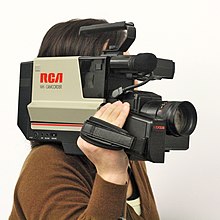
This older RCA camcorder records on standard analog VHS media. Its bulk- partly due to the utilize of full-size VHS cassettes- makes it more than suited to shoulder-mounted use, equally seen here.
Camcorders are often classified past their storage device; VHS, VHS-C, Betamax, Video8 are examples of late 20th century videotape-based camcorders which tape video in analog class. Digital video camcorder formats include Digital8, MiniDV, DVD, hd, directly to deejay recording and solid-state, semiconductor flash retentiveness. While all these formats record video in digital form, Digital8, MiniDV, DVD and hard-disk drives[xiii] have no longer been manufactured in consumer camcorders since 2006.
In the earliest analog camcorders the imaging device is vacuum-tube applied science, in which the charge of a lite-sensitive target was direct proportional to the corporeality of low-cal hit it; the Vidicon is an example of such an imaging tube. Newer analog, and digital camcorders use a solid-country charge-coupled imaging device (CCD) or a CMOS imager. Both are analog detectors, using photodiodes to pass a electric current proportional to the light striking them. The current is then digitised before beingness electronically scanned and fed to the imager's output. The main difference between the two devices is how the scanning is done. In the CCD the diodes are sampled simultaneously, and the browse passes the digitised data from one annals to the next. In CMOS devices, the diodes are sampled directly by the scanning logic.
Digital video storage retains higher-quality video than analog storage, especially on the prosumer and strictly consumer levels. MiniDV storage allows full-resolution video (720x576 for PAL, 720x480 for NTSC), unlike analog consumer-video standards. Digital video does not feel colour bleeding, jitter, or fade.
Unlike analog formats, digital formats practise not experience generation loss during dubbing; however, they are more prone to complete loss. Although digital information can theoretically be stored indefinitely without deterioration, some digital formats (like MiniDV) place tracks but about 10 micrometers apart (compared with nineteen–58 μm for VHS). A digital recording is more vulnerable to wrinkles or stretches in the record which could erase data, but tracking and error-correction code on the tape compensates for most defects. On analog media, similar harm registers as "noise" in the video, leaving a deteriorated (but watchable) video. DVDs may develop DVD rot, losing big chunks of data. An analog recording may be "usable" afterwards its storage media deteriorates severely, simply[xiv] slight media degradation in digital recordings may trigger an "all or naught" failure; the digital recording will exist unplayable without extensive restoration.
Recording media [edit]
Older digital camcorders record video onto record digitally, microdrives, hard drives, and minor DVD-RAM or DVD-Rs. Newer machines since 2006 tape video onto flash retention devices and internal solid-state drives in MPEG-1, MPEG-2 or MPEG-4 format.[15] Considering these codecs apply inter-frame compression, frame-specific editing requires frame regeneration, additional processing and may lose motion-picture show information. Codecs storing each frame individually, easing frame-specific scene editing, are common in professional person utilise.
Other digital consumer camcorders record in DV or HDV format on tape, transferring content over FireWire or USB 2.0 to a estimator where large files (for DV, 1GB for 4 to iv.6 minutes in PAL/NTSC resolutions) can be edited, converted and recorded back to record. The transfer is washed in existent time, so the transfer of a 60-infinitesimal record requires i hour to transfer and about 13GB of disk space for the raw footage (plus space for rendered files and other media).
Tapeless [edit]
A tapeless camcorder is a camcorder that does not employ video tape for the digital recording of video productions as 20th century ones did. Tapeless camcorders record video as digital computer files onto data storage devices such as optical discs, hard deejay drives and solid-state flash memory cards.[16]
Inexpensive pocket video cameras use wink retentiveness cards, while some more than expensive camcorders utilise solid-state drives or SSD; similar flash technology is used on semi-pro and high-end professional video cameras for ultrafast transfer of loftier-definition television set (HDTV) content.
About consumer-level tapeless camcorders utilize MPEG-2, MPEG-four or its derivatives as video coding formats. They are normally capable of yet-image capture to JPEG format additionally.
Consumer-course tapeless camcorders include a USB port to transfer video onto a computer. Professional models include other options like Serial digital interface (SDI) or HDMI. Some tapeless camcorders are equipped with a FireWire (IEEE-1394) port to ensure compatibility with magnetic record-based DV and HDV formats.
Consumer market [edit]
Since the consumer market favors ease of utilize, portability and price, well-nigh consumer-grade camcorders emphasize handling and automation over audio and video functioning. Most devices with camcorder capability are camera phones or meaty digital cameras, in which video is a secondary capability. Some pocket cameras, mobile phones and camcorders are daze-, grit- and waterproof.[17]
The consumer camcorder was by and large all the same very expensive throughout the early to mid 1990s merely prices compared to the 1980s had halved for an entry level model and fell fifty-fifty further at the turn of the millennium placing them in easier reach of bones income consumers with the add-on of available and more easy to obtain credit to spread payments.
This market has followed an evolutionary path driven by miniaturization and cost reduction enabled by progress in pattern and industry. Miniaturization reduces the imager's ability to gather light; designers have balanced improvements in sensor sensitivity with size reduction, shrinking the camera imager and eyes while maintaining relatively noise-free video in daylight. Indoor or dim-light shooting is mostly noisy, and in such conditions artificial lighting is recommended. Mechanical controls cannot shrink below a certain size, and manual photographic camera performance has given way to camera-controlled automation for every shooting parameter (including focus, aperture, shutter speed and color balance). The few models with manual override are carte-driven. Outputs include USB 2.0, Composite and S-Video and IEEE 1394/FireWire (for MiniDV models).
The high end of the consumer market emphasizes user control and advanced shooting modes. More than-expensive consumer camcorders offer transmission exposure control, HDMI output and external audio input, progressive-scan frame rates (24fps, 25fps, 30fps) and higher-quality lenses than basic models. To maximize low-light capability, color reproduction and frame resolution, multi-CCD/CMOS camcorders mimic the 3-element imager pattern of professional equipment. Field tests take shown that most consumer camcorders (regardless of price) produce noisy video in depression light.
Before the 21st century, video editing required 2 recorders and a desktop video workstation to control them. A typical home personal computer can hold several hours of standard-definition video, and is fast plenty to edit footage without additional upgrades. Most consumer camcorders are sold with bones video editing software, so users can create their own DVDs or share edited footage online.
Since 2006, nearly all camcorders sold are digital. Tape-based (MiniDV/HDV) camcorders are no longer popular, since tapeless models (with an SD menu or internal SSD) cost virtually the same but offering greater convenience; video captured on an SD card tin be transferred to a calculator faster than digital tape. None of the consumer-class camcorders appear at the 2006 International Consumer Electronics Evidence recorded on tape.[one]
Other devices [edit]
Video-capture capability is not confined to camcorders. Cellphones, digital single-lens reflex and compact digicams, laptops and personal media players offer video-capture adequacy, but most multipurpose devices offer less video-capture functionality than an equivalent camcorder. Nigh lack manual adjustments, sound input, autofocus and zoom. Few capture in standard TV-video formats (480p60, 720p60, 1080i30), recording in either not-TV resolutions (320x240, 640x480) or slower frame rates (15 or xxx fps).
A multipurpose device used as a camcorder offers inferior handling, sound and video operation, which limits its utility for extended or adverse shooting situations. The camera phone developed video capability during the early 21st century, reducing sales of low-end camcorders.
DSLR cameras with loftier-definition video were also introduced early in the 21st century. Although they still take the handling and usability deficiencies of other multipurpose devices, HDSLR video offers the shallow depth-of-field and interchangeable lenses defective in consumer camcorders. Professional person video cameras with these capabilities are more expensive than the nearly expensive video-capable DSLR. In video applications where the DSLR's operational deficiencies tin can be mitigated, DSLRs such equally the Catechism 5D Marker Two provide depth-of-field and optical-perspective control.
Philharmonic-cameras combine full-feature still cameras and camcorders in a single unit. The Sanyo Xacti HD1 was the first such unit, combining the features of a 5.one megapixel still camera with a 720p video recorder with improved handling and utility. Canon and Sony accept introduced camcorders with still-photo performance budgeted that of a digicam, and Panasonic has introduced a DSLR trunk with video features approaching that of a camcorder. Hitachi has introduced the DZHV 584E/EW, with 1080p resolution and a touch screen.
Flip Video [edit]
The Flip Video was a series of tapeless camcorders introduced past Pure Digital Technologies in 2006. Slightly larger than a smartphone, the Flip Video was a basic camcorder with tape, zoom, playback and browse buttons and a USB jack for uploading video. The original models recorded at a 640x480-pixel resolution; later models featured HD recording at 1280x720 pixels. The Mino was a smaller Flip Video, with the same features as the standard model. The Mino was the smallest of all camcorders, slightly wider than a MiniDV cassette and smaller than nearly smartphones on the marketplace. In fact the Mino was small-scale plenty to fit inside the shell of a VHS cassette. Later HD models featured larger screens. In 2011, the Flip Video (more recently manufactured by Cisco) was discontinued.[eighteen]
Interchangeable lenses [edit]
Interchangeable-lens camcorders can capture HD video with DSLR lenses and an adapter.[nineteen]
Congenital-in projector [edit]
In 2011, Sony launched its HDR-PJ range of Hd camcorders: the HDR-PJ10, 30 and 50. Known equally Handycams, they were the first camcorders to incorporate a small image projector on the side of the unit of measurement. This feature allows a grouping of viewers to lookout video without a television, a full-size projector or a estimator. These camcorders were a huge success and Sony subsequently released farther models in this range. Sony's 2014 line up comprises the HDR-PJ240, HDR-PJ330 (entry level models), HDR-PJ530 (mid-range model) and the HDR-PJ810 (superlative of the range).[twenty] Specifications vary by model.[21]
Uses [edit]
Media [edit]

Professional TV camcorder (1990s-era)
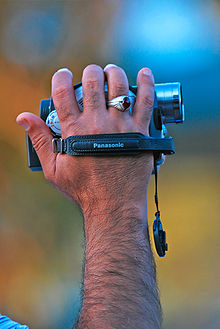
Operating a Panasonic VDRM70 DVD camcorder with one hand
Camcorders are used by nearly all electronic media, from electronic-news organizations to current-diplomacy TV productions. In remote locations, camcorders are useful for initial video conquering; the video is subsequently transmitted electronically to a studio or product center for broadcast. Scheduled events (such as press conferences), where a video infrastructure is readily available or tin be deployed in advance, are however covered past studio-type video cameras "tethered" to production trucks.
Home movies [edit]
Camcorders frequently cover weddings, birthdays, graduations, children's growth and other personal events. The rise of the consumer camcorder during the mid- to late 1980s led to the creation of TV shows such as America's Funniest Dwelling Videos, which showcases homemade video footage.
Entertainment [edit]
Camcorders are used in the production of depression-budget Boob tube shows if the production crew does not have access to more expensive equipment. Movies have been shot entirely on consumer camcorder equipment (such as The Blair Witch Project, 28 Days Subsequently and Paranormal Activity). Bookish filmmaking programs have too switched from 16mm film to digital video in early on 2010s, due to the reduced expense and ease of editing of digital media and the increasing scarcity of film stock and equipment. Some camcorder manufacturers cater to this market place; Catechism and Panasonic support 24p (24 fps, progressive scan—the aforementioned frame rate as movie house film) video in some loftier-end models for easy film conversion.
Teaching [edit]
Schools in the developed earth increasingly use digital media and digital education. Students use camcorders to tape video diaries, brand curt films and develop multi-media projects beyond subject boundaries. Instructor evaluation involves a teacher's classroom lessons being recorded for review by officials, especially for questions of teacher tenure.
Educatee camcorder-created fabric and other digital engineering science are used in new-instructor preparation courses. The University of Oxford Section of Instruction PGCE programme and NYU's Steinhardt School'south Section of Teaching and Learning MAT programme are examples.
The USC Rossier School of Education goes further, insisting that all students purchase their own camcorder (or like) every bit a prerequisite to their MAT education programs (many of which are delivered online). These programs employ a modified version of Adobe Connect to deliver the courses. Recordings of MAT student work are posted on USC'southward web portal for evaluation by faculty every bit if they were nowadays in class. Camcorders have allowed USC to decentralize its teacher preparation from Southern California to most American states and abroad; this has increased the number of teachers it tin railroad train.
Formats [edit]
The following listing covers consumer equipment but (for other formats, see videotape):
Analog [edit]

Lo-Band: Approximately iii MHz bandwidth (250 lines Eia resolution, or ~333x480 border-to-edge)
- BCE (1954): Get-go tape storage for video, manufactured by Bing Crosby Entertainment from Ampex equipment
- BCE Color (1955): First colour record storage for video, manufactured by Bing Crosby Entertainment from Ampex equipment
- Simplex (1955): Developed commercially by RCA and used to record live broadcasts by NBC
- Quadruplex videotape (1955): Developed formally by Ampex, this was the recording standard for xx years.
- Vision electronic recording appliance (Vera) (1955): An experimental recording standard developed by the BBC, it was never used or sold commercially.
- U-matic (1971): Tape originally used by Sony to tape video
- U-matic S (1974): A smaller version of U-matic, used for portable recorders
- Betamax (1975): Used on erstwhile Sony and Sanyo camcorders and portables; obsolete past the late 1980s in the consumer market
- VHS (1976): Compatible with VHS VCRs; no longer manufactured
- VHS-C (1982): Originally designed for portable VCRs, this standard was later adjusted for meaty consumer camcorders; identical in quality to VHS; cassettes play in VHS VCRs with an adapter. Still bachelor in the low-end consumer marketplace. Relatively brusk running fourth dimension compared to other formats.
- Video8 (1985): Small-format tape developed by Sony to compete with VHS-C's palm-sized design; equivalent to VHS or Betamax in picture show quality
Hullo-Band: Approximately 5 MHz bandwidth (420 lines Eia resolution, or ~ 550x480 edge-to-edge)
- U-matic BVU (1982): Largely used in high-stop consumer and professional equipment
- U-matic BVU-SP (1985): Largely used in high-end consumer and professional equipment
- South-VHS (1987): Largely used in mid-range consumer and prosumer equipment
- S-VHS-C (1987): Express to low-terminate consumer market place
- Hi8 (1988): Used in low to mid-range consumer equipment simply also was available as prosumer/industrial equipment
Digital [edit]

Sony Handycam DCR-IP7BT MICROMV camcorder and Sony MICROMV record (top), compared with MiniDV and Hi8 tapes
- DV (1995): Initially developed by Sony, the DV standard became the near widespread standard-definition digital camcorder technology for the next decade. The DV format was the kickoff to make capturing footage for video editing possible without special hardware, using the 4- or 6-pin FireWire sockets common on computers at the time.[22] [ failed verification ]
- DVCPRO (1995): Panasonic released its own variant of the DV format for broadcast news-gathering.
- DVCAM (1996): Sony's reply to the DVCPRO
- DVD recordable (1996): A variety of recordable optical disc standards were released by multiple manufacturers during the 1990s and 2000s, of which DVD-RAM was the showtime. The virtually mutual in camcorders was MiniDVD-R, which used recordable viii cm discs belongings 30 minutes of MPEG video.
- D-VHS (1998): JVC'south VHS tape supporting 720p/1080i Hard disk; many units also supported IEEE 1394 recording.
- Digital8 (1999): Uses Hi8 tapes; most can read older Video8 and Hi8 analog tapes.
- MICROMV (2001): Matchbox-sized cassette. Sony was the only electronics manufacturer for this format, and editing software was proprietary to Sony and only bachelor on Microsoft Windows; yet, open source programmers did manage to create capture software for Linux.[23]
- Blu-ray Disc (2003): Manufactured by Hitachi
- HDV (2004): Records up to an hour of HDTV MPEG-two signal on a MiniDV cassette
- MPEG-2 codec-based format: Records MPEG-two program stream or MPEG-2 transport stream to various kinds of tapeless standard and HD media (hard disks, solid-state retentiveness, etc.).
- H.264: Compressed video using the H.264 codec in an MPEG-4 file; normally stored in tapeless media
- AVCHD: Puts H.264 video into a transport-stream file format; compressed in H.264 format (not MPEG-4)
- Multiview Video Coding: Amendment to H.264/MPEG-four AVC video compression for sequences captured from multiple cameras using a unmarried video stream; backwards-compatible with H.264
Operating systems [edit]
Since nigh manufacturers focus their support on Windows and Mac users, users of other operating systems take difficulty finding support for their devices. However, open-source products such as Kdenlive, Cinelerra and Kino (written for the Linux operating organization) allow editing of most pop digital formats on alternative operating systems and tin exist used in conjunction with OBS for online broadcast solutions; software to edit DV streams is bachelor on nearly platforms.
Digital forensics [edit]
The effect of digital-camcorder forensics to recover data (e.thou. video files with timestamps) has been addressed.[24]
Recalls [edit]
In 1998, Sony recalled an estimated 700,000 1998 Sony Handycams subsequently the NightShot characteristic was found to be able to see nether peoples clothes, creating a risk for accidental pornographic recording.[25]
See also [edit]
- 3CCD
- AVCHD
- Charge-coupled device
- CMOS
- Dew warning
- FireWire
- Flip Video
- PictBridge
- Pocket video camera
- Professional video photographic camera
- PXL-2000—A toy camcorder that used compact audio cassette to store video
- SteadyShot
- USB streaming and USB port.
- VTR
- List of Sony camcorders
- List of Panasonic camcorders
References [edit]
- ^ a b "Archived copy". Archived from the original on 2013-01-02. Retrieved 2011-01-07 .
{{cite web}}: CS1 maint: archived copy as championship (link) - ^ "Britannica online encyclopedia: camcamcorder". Archived from the original on 2009-12-10. Retrieved 2008-08-05 .
- ^ a b "Split up photographic camera and recorder; First VHS-C camcorder". 2007-09-14. Archived from the original on 2008-10-16. Retrieved 2007-09-14 .
- ^ a b c David Buckingham, Rebekah Willett, Maria Pini (2011), Home Truths? Video Production and Domestic Life, page ix Archived 2018-05-10 at the Wayback Motorcar, University of Michigan Press
- ^ Amit Dhir (2004), The Digital Consumer Technology Handbook: A Comprehensive Guide to Devices, Standards, Futurity Directions, and Programmable Logic Solutions, page 263 Archived 2018-04-07 at the Wayback Machine, Elsevier
- ^ JVC Everio GS-TD1 Review – TrustedReviews – June 1, 2011 7:15 am BST
- ^ Seth Barton (January nine, 2014). "Sony FDR-AX100 review - Easily on with first consumer 4K camcorder". Archived from the original on January 13, 2014.
- ^ Dan Chung (three September 2014). "B+H give first expect at Panasonic HC-X1000 4K Camcorder". Archived from the original on December 27, 2014. Retrieved December 27, 2014.
- ^ Sony DCR-PC3 user transmission
- ^ Panasonic HC-V500/V500M Total HD camcorder – B&H Photo & Video
- ^ a b Panasonic HC-V500 and HC-V500M user manual (mirror)
- ^ "Sony Digital Video Recorder Handycam Operating Guide – DCR-HC52/HC54 (MiniDV)" (PDF). Sony. 2008. p. 34. Retrieved 2022-01-17 .
- ^ Snow, Christopher (January 9, 2012). "Sony reveals Spring Handycam lineup, including CX760V, XR260V, and CX190". Reviewed.com Camcorders . Retrieved Oct 22, 2013.
- ^ "Videotape Life Expectancy". Video Tape Word. Archived from the original on February five, 2013. Retrieved Oct 22, 2013.
- ^ McCabe, Liam F. (January 7, 2013). "Sony Launches Six New Entry-Level Camcorders for 2013". Reviewed.com Camcorders . Retrieved October 22, 2003.
- ^ Pogue, David (September 20, 2007). "Beware the tapeless camcorder". The New York Times. Archived from the original on November 29, 2016.
- ^ "Kodak PlaySport Zx5 Review". July 19, 2006. Archived from the original on Jan 17, 2012.
- ^ Reardon, Marguerite (April 13, 2011). "Why Cisco killed the Flip mini camcorder". CNET. Archived from the original on October 25, 2013. Retrieved October 22, 2013.
- ^ "Sony NEX-VG10: An HD Camcorder With DSLR Brains". August 13, 2011. Archived from the original on September 8, 2012.
- ^ "Handycam Hard disk drive camcorder with built in projector: Sony". Nov 1, 2011. Archived from the original on April 5, 2012.
- ^ http://www.sony.co.uk/hub/handycam-camcorders/features/projector-camcorders Archived January 17, 2013, at the Wayback Machine
- ^ "Transfer Video from your Camcorder to Your PC". New Moving ridge Boob tube. Archived from the original on 23 May 2011. Retrieved 15 August 2011.
- ^ Dennedy, Dan (Baronial 2, 2003). "MicrMV capture". Kino Video Editor. Archived from the original on February 22, 2012. Retrieved October 23, 2013.
- ^ Ariffin, Aswami; Choo, Kim-Kwang Raymond; Slay, Jill. Thomborson, C.; Parampalli, U. (eds.). "Digital Camcorder Forensics" (PDF). Conferences in Inquiry and Exercise in It. 138. Archived (PDF) from the original on October 23, 2013. Retrieved October 22, 2013.
- ^ Whigham, Nick (29 June 2016). "Sony recalled photographic camera in 1998 that could see through people'south clothes". News.com.au — Australia'south Leading News Site . Retrieved April 24, 2021.
External links [edit]
 | Wikimedia Commons has media related to Camcorders. |
 | Await upward camcorder in Wiktionary, the gratuitous lexicon. |
- History of Camcorders by Mark Shapiro
- How Camcorders Work from HowStuffWorks
Source: https://en.wikipedia.org/wiki/Camcorder#:~:text=The%20rise%20of%20the%20consumer,which%20showcases%20homemade%20video%20footage.
Posted by: colewittionfer.blogspot.com
0 Response to "When Did Video Cameras Become Popular"
Post a Comment