

How To Describe Camera Angles
Yous want a list of diverse camera angles in movies, as well as fantastic examples with clear explanations of when and why to utilize each 1. The importance of camera angles cannot be overstated, whether you lot want your characters to appear powerful, vulnerable, or intimate. Therefore, we will provide you lot with shot lists with all the camera shot angles used in movies.
Video: Guide to Camera Angles
Overview of Camera Shot Angles
It is non enough to know how big a shot is. The degree of photographic camera angles can completely change the meaning of a photograph. It is easier to remember all the options when you lot're making your shot list. We will use StudioBinder to create a shot list that highlights the diverse camera viewpoints. Hither is a uncomplicated video on how to make a shot listing.
Video: Shot Listing Guide for Filmmakers
Shot List With Examples
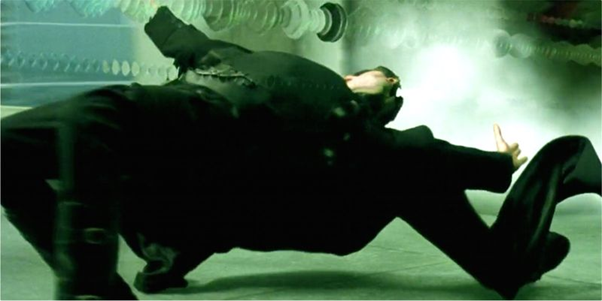
The following is a short shot list with the various camera shot angles. Every bit a sort of cheatsheet, we used some of the almost memorable camera angles from films similar The Matrix, Exercise the Correct Thing, and Lurid Fiction.
Depression Angle
The subject field is framed from below their centre line in a depression-angle manner. A depression-bending shot of one grapheme is oftentimes coupled with a high-angle film of the other character to illustrate power dynamics between characters.
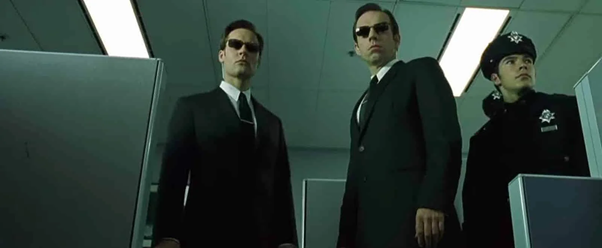
A Scene From Matrix
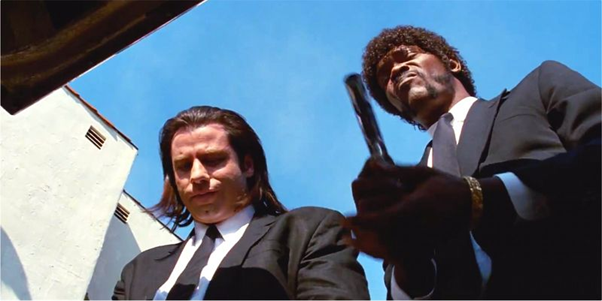
A Scene From Pulp Fiction
Low-angle photographic camera angles are ideal for conveying supremacy or instilling feelings of terror and dread. Here's a movie that goes over some of the many low-angle shot examples and how filmmakers similar Wes Anderson, Orson Welles, and Spike Jonze have used them. You can learn more than nigh low-angle shots here.
Video Link: Low Bending
High Bending
The photographic camera, in a high-angle shot, is pointing downwards at your subject area. Information technology frequently makes yous feel inferior to your subject field as if you are "looking down" on them. Still, equally with any other photographic camera angle, at that place are several applications.
Here's a video showing how to incorporate high-angle images into your flick. However, as the movie beneath demonstrates, yous may use the high angle shot in traditional and more innovative ways.
Video: High Bending
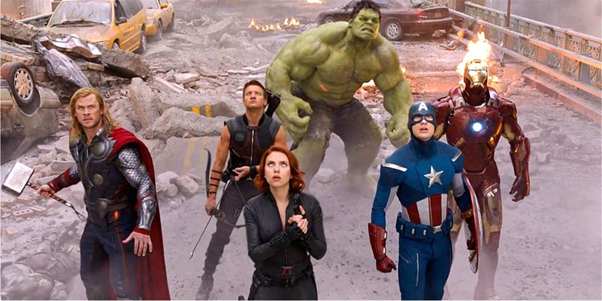
The Avengers
Dutch Angle
The camera is inclined to one side for a Dutch angle (Dutch tilt). You tin generate a sensation of disorientation, a destabilized mental state, or heighten tension past tilting the horizon lines in this way.
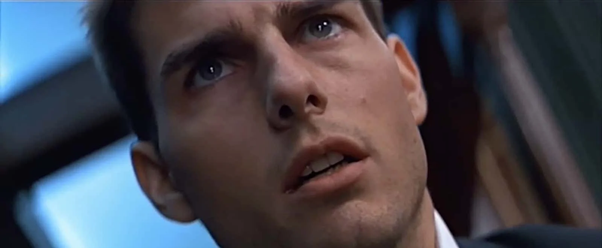
Mission Impossible
Hither's a video demonstrating a Dutch camera angle in action, focused on the exact timing of using one. Watch every bit the scene starts with "regular" and "level" shots before transitioning to Dutch angles for maximum issue.
Video: Dutch Angle Shot
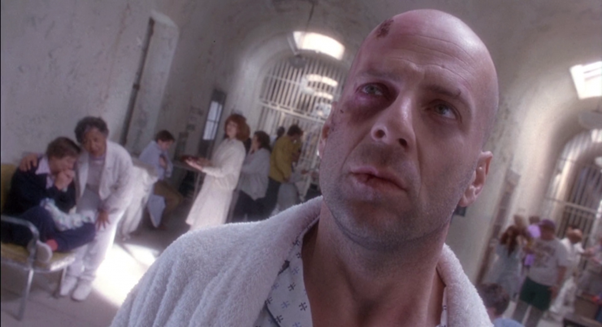
Twelve Monkeys
You can learn more about Dutch angle shots here.
Overhead Shot
An overhead shot is taken from above and looks downwardly on your subject. These are usually filmed from 90 degrees in a higher place; anything less would be termed a low-bending shot.
An overhead shot doesn't need to be extremely high, only it can exist. Hither's an example of a camera angle used for an overhead shot
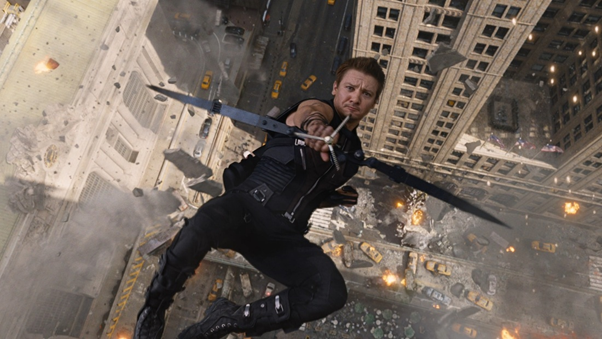
Avengers
Video: Overhead Shot Scene
Overhead views are fantabulous for giving a scene perspective — but not just any perspective. It is frequently employed equally a "neutral" or even "divine" viewpoint.
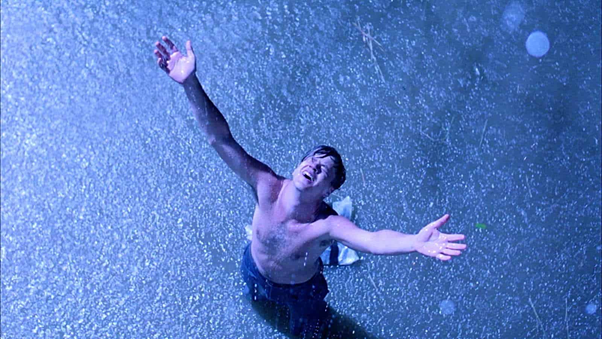
Shawshank Redemption
You can learn more about overhead-shot here.
Eye Level
You can accomplish a neutral perspective by shooting at eye level (non superior or inferior). This is similar to how we view people in real life, with our eye lines intersecting with theirs, and it has the potential to tear down barriers.
Here's an instance of a camera angle at eye level:
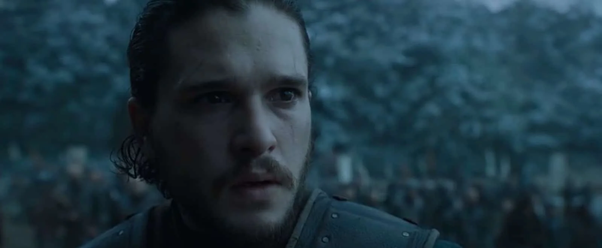
Game of Thrones
Video: Eye Level Shot Example
Directors oft choose to set the photographic camera at shoulder level to provide a much more cinematic result. Therefore, heart-level shots are far less common than 1 might imagine.
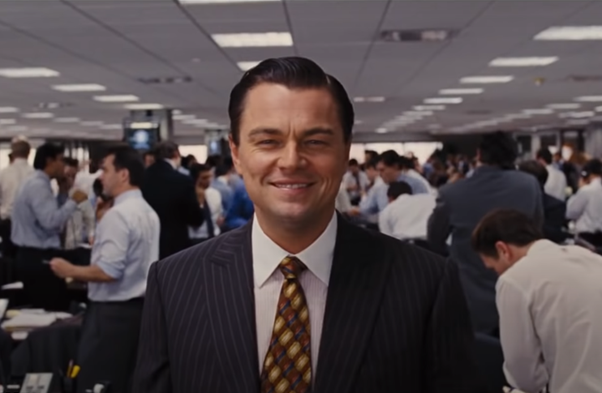
The Wolf of Wall Street
Shoulder Level
A camera bending that is as high as your subject'southward shoulders is known equally a shoulder-level shot. Shoulder-level shots are more common than centre-level shots, which can make your performer announced shorter than he or she is.
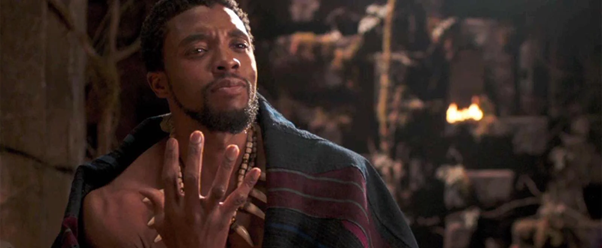
Black Panther
The histrion'southward head can reach the acme of the frame because the photographic camera is aligned with the shoulder. Information technology besides raises the actor's eye line slightly above the camera, giving the impression of a lower viewpoint.
Over the Shoulder Shot/OTS Shot
Another angle that might alter a viewer'south perception of a scene is an over-the-shoulder shot. For example, a close-upwards of some other character's face taken from "over the shoulder" of another character is used to show disharmonize or confrontation in an OTS shot.
When you lot don't want to use a POV, y'all tin can use an OTS wide shot to portray a graphic symbol looking out over a landscape or going through an action sequence.
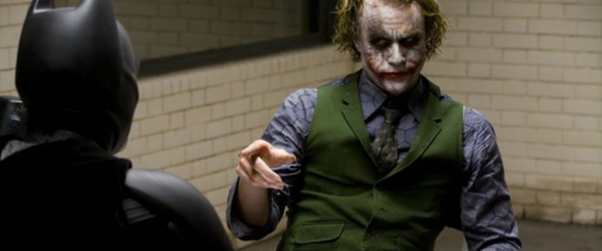
The Dark Knight
Video: Over the Shoulder Shots
Y'all tin can acquire more most over-the-shoulder shots here.
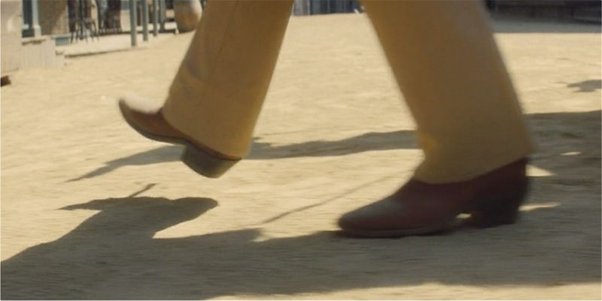
Hip Level or Cowboy Shot
When your camera is around waist-high, you're taking a cowboy shot. However, hip-level pictures are typically beneficial when 1 person is seated, and the other is standing.
When you take the action near the hip, such as guns being fatigued or someone reaching into their pocket, hip-level shots can be incredibly effective camera angles. That is why it's also known as a "cowboy shot," as we cannot call up most hip-level shots without seeing a gun, holster, and a afar enemy.
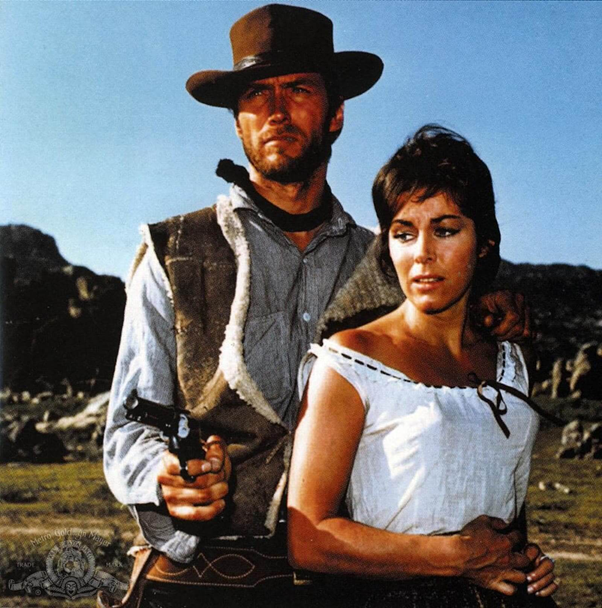
A Fistful Of Dollars (1964)
A hip level shot will get the task washed the further away yous motility from the field of study, such in this scene from Punch-Drunk Honey, to maintain the discipline framed with sufficient headroom.
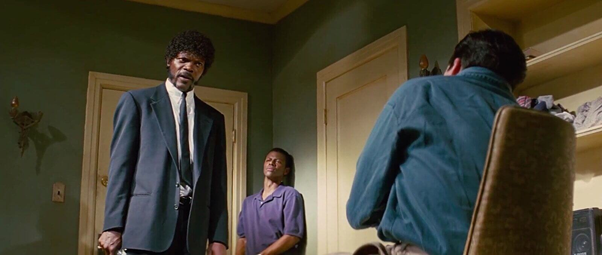
Pulp Fiction
You lot can learn more about cowboy or hip-level shot here.
Knee joint Level
When your camera is roughly as depression as your subject's knees, you're in this position. When used with a low viewpoint, they might accentuate a grapheme's supremacy. It's not as dramatic as a ground-level image, just it conveys the aforementioned emotion. These are great for focusing on characters strolling, or in this example, creeping, as in Habitation Alone.
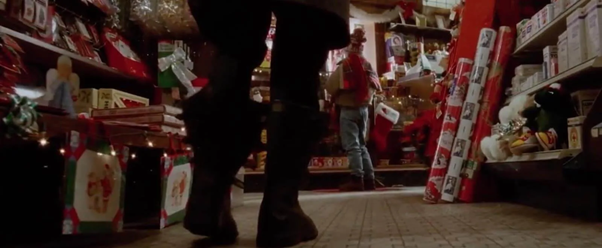
Home Alone
The Matrix
Scene From The Movie
Shot Size
The size of the frame in proportion to the subject area is referred to every bit shot size.Is your grapheme in the moving picture, or is the character so far away that he/she is virtually invisible? What more tin you run across in your photograph? Is information technology possible to have many characters? Objects? Landscapes?
Let's take a look at the v most mutual shot sizes and how they work:
Close-up (CU)
One of the most prevalent shot sizes in movie house is the close-up. Information technology's employed when yous want to focus on your grapheme's facial features without any extraneous distractions in the image. For example, the grapheme'due south confront is shown in a standard close-upwardly from the brow to the chin.
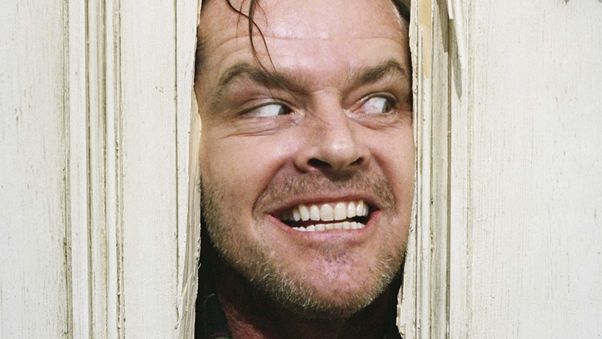
The Shining
There is, nevertheless, room for some creativity. An extreme close-up goes even further, frequently revealing but the character'southward eyes. Consider a classic Western in which 2 characters confront off earlier a duel. The viewer's attention is drawn to facial features and expressions that would otherwise exist lost in a wide shot.
Video: Close Up Shots
Long Shot
In some senses, a long shot is the polar opposite of a close-upwards. It encompasses the complete body of the character, from head to toe. This provides a better experience of the subject area's surroundings and conveys information otherwise lost in a shut-upward.
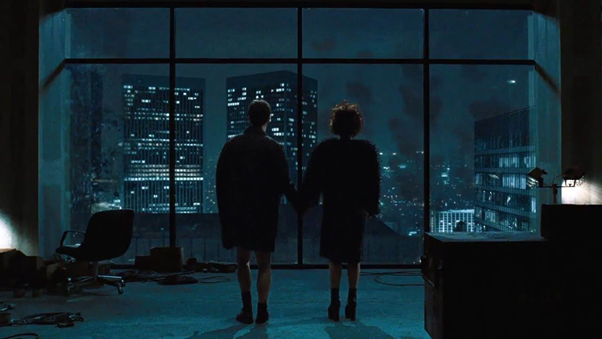
The Fight Club
When it's crucial to show how the discipline moves through his or her environment, long shots are ofttimes used in action scenes. You may cut from that extreme close-up of your two warring characters to a long shot that illustrates just how far autonomously they are, giving the audience a clearer perspective on the issue.
1 variation of this shot is an extreme long shot, in which the graphic symbol is and so far abroad they're nearly lost in the frame or obscured by their surroundings. Retrieve of a character riding off into the sunset, getting smaller equally they get farther away from the photographic camera.
Video: Long/Wide Shot
Medium Shot
A medium shot, likewise known as a mid-shot, falls in betwixt a close-upward and a long shot. The subject is shown from the pinnacle of their head to the lesser of their waist. It's close enough to see their faces while besides getting a glimpse of their trunk language.
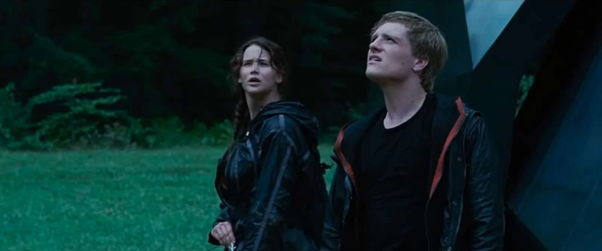
The Hunger Games
When a character is carrying an object or pointing a gun, you tin apply this shot. Y'all can even use this shot while writing a book sitting at a desk, fugitive wasting valuable screen space on the grapheme's feet or knees.
It is as well handy when a character moves around the frame. It provides enough background information to keep the viewer from existence disoriented.
Video: The Fine art of the Medium Shot
Single, two shot, 3-shot
The quantity of individuals in the frame is another technique to classify a photo. Depending on how many people are in it, we phone call it a single shot, a two-shot, or a three-shot.
This is ordinarily combined with one of the other shot sizes we take discussed so far. A 2-shot shut-upwards, for example, could exist used in a kissing scene between two people. A medium three-shot tin can exist appropriate for three characters in an office.
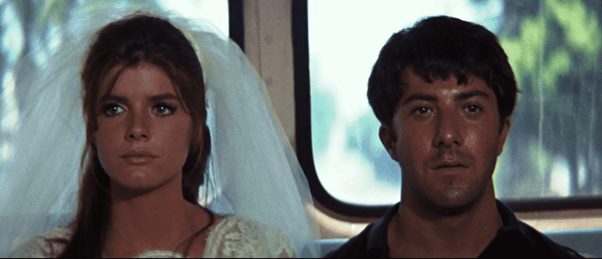
The Graduate
Indicate of View/POV Shot
Last but not least, there's the POV (signal-of-view) photo. This is utilized when you lot desire the audience to run into or experience what the character sees or feels.
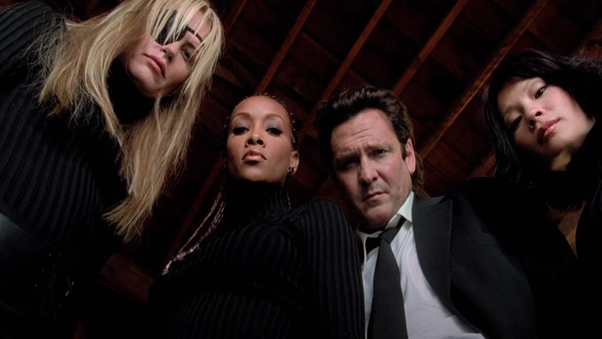
Django Unchained
Video: Point Of View Shot
Camera Movement
Camera motion or movement is the next category we'll await at. Y'all can use near of the shot sizes and angles we've examined as static or moving shots. However, you may switch betwixt camera viewpoints past calculation motion to a flick, sometimes even within the same shot. Allow'due south take a look at five popular camera movements:
Video: Camera Movement
Pan or Tilt
A pan or tilt is the most basic photographic camera motility. A pan is when you lot keep the camera all the same and turn it to the side, while a tilt is when you move it upwardly or down.
If your photographic camera is on a tripod, you tin simply plow the tripod caput to one side to learn a different viewpoint on a subject, just every bit yous would plough your head to one side to gain a unlike perspective on a scene. For instance, you tin modify an eye-level shot into a low-angle shot by tilting the photographic camera upward as the subject rises.
Experimenting with speed while panning or tilting is as well a nice idea. You tin can show off a room or a landscape by panning slowly from left to right for an entire minute, or you tin execute a whip pan, in which the motion is so quick that information technology blurs.

Tracking Shot, Dolly Shot, or Crane Shot
The key to a pan or tilt is that the camera does non move, giving the viewer the impression of being a spectator. You can use a tracking shot, dolly shot, or crane shot to proceed with a subject and make the audience feel like they're a part of the action.
A tracking shot oftentimes moves horizontally, a dolly shot forwards or astern, and a crane shot upward or downward. Depending on your equipment, you can utilise these movements separately or combine them to move on many axes at in one case.

Zoom
Instead of moving the camera, a zoom shot uses a zoom lens to movement into or out of the frame. Slowly zoom in on a subject'southward face up equally they deliver an emotional monologue to make a medium shot into a close-up. You can even zoom out to run across a previously unseen individual or object.
A zoom shot might exist slow and subtle, then the viewer doesn't notice information technology, or information technology can be more than noticeable to give the scene a cinematic experience.
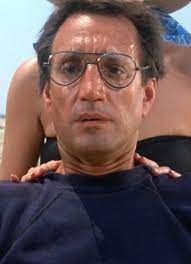
Jaws
Random Motion
Random movement is utilized to add energy and excitement to a scene, especially in action scenes. For example, consider The Bourne Identity. The camera moves so swiftly that the scene's subject is not always framed in the frame.
While random motion might aid create a sense of disorientation, information technology tin also exist overpowering, leaving viewers light-headed and bewildered.
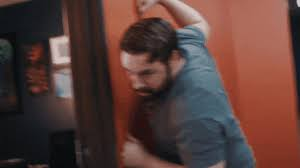
Scene From the Movie
360-Degree Motion
The final sort of motion we'll expect at is 360-degree motion, which involves the photographic camera rotating entirely around the bailiwick of the shot. These images are increasingly popular in the days of Steadicams and CGI. Nonetheless, they can be challenging to achieve on large picture sets because they crave hiding the personnel and equipment from view.
The Matrix used a unique camera setup for its 360-degree fight scenes, simply y'all tin can also use a handheld camera or a drone.

Compound Motion
The dazzler of camera motion is that it does non have to be express to but one axis at a time. Combining movements allows y'all to movement in many dimensions simultaneously, resulting in more complicated images. Let's look at two famous chemical compound shots:
- Dolly Zoom: The dolly zoom is employed to elicit a feeling of dizziness or uneasiness. It was utilized in Alfred Hitchcock's Vertigo and Steven Spielberg's Jaws, among other films. In this shot, the camera moves forward or backward while the lens zooms in the opposite management.
- Unmarried Take: A single take is a long shot that incorporates several moves, shot sizes, and views. Instead of transitioning from a long shot to a shut-up, the camera could track, zoom, pan, and tilt between several different shots. This is the most hard to exercise properly, but information technology's an efficient technique to orient viewers to a new place, equally shown in Goodfellas' opening image. It tin besides give a movie a theatrical experience, such as in Birdman, shot in i long shot.

Conclusion
Camera Angles are non only a function of jargon to intellectualize the process of filmmaking. They are also used to communicate the nuances and subtleties of the state of affairs. They offer a peachy bargain of insight into a character's thought process and help the viewer empathise the intricacies in a scene.
Source: https://www.nfi.edu/camera-angles/
Posted by: colewittionfer.blogspot.com
0 Response to "How To Describe Camera Angles"
Post a Comment